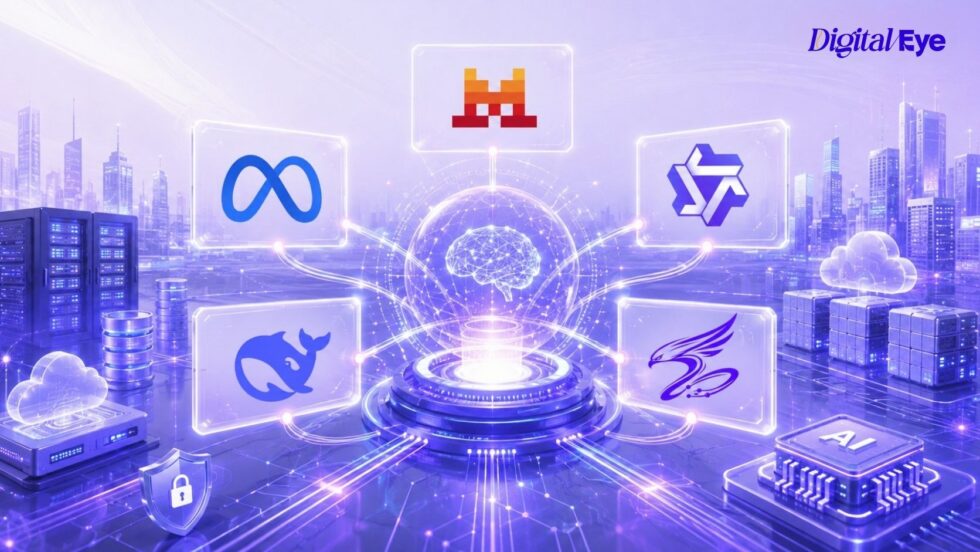
Llama 4, Qwen 3, Mistral, Falcon, and DeepSeek are the open-weight models Pakistani enterprises need to understand in 2026. Here is the practical guide.
The most consequential shift in enterprise AI over the past eighteen months has not been the release of any single model. It has been the arrival of open-weight AI at a quality level that genuinely competes with the frontier closed systems. Organisations that were paying ongoing API fees to access GPT-4-level reasoning can now deploy models of equivalent capability on infrastructure they control, at costs that do not scale with every API call, without routing their data through a foreign provider’s servers.
For Pakistani enterprises, this shift is particularly significant. Data sovereignty requirements under the National Data Governance Policy 2026 and SBP data residency rules create compliance pressure toward on-premise or locally hosted AI. The NTC’s sovereign GPU infrastructure already hosts Llama 3.1 and GPT OSS 20B for government institutions. And Pakistan’s IT firms delivering AI-powered services internationally need to understand the open-weight landscape as well as the vendors their clients are already evaluating.
What follows is a practical guide to the five open-weight model families Pakistani enterprises and IT firms need to understand in 2026, covering what each one is, what it costs to run, and why it matters for a Pakistani deployment context specifically.
Llama 4 (Meta)
Meta’s Llama 4 family represents the most widely deployed open-weight model architecture globally. The family currently includes Llama 4 Scout, a mixture-of-experts model with 17 billion active parameters designed to run on a single GPU, and Llama 4 Maverick, which matches GPT-4o performance on most benchmarks while remaining deployable on modest GPU infrastructure.
Llama 4 is distributed under Meta’s community licence rather than a fully permissive open-source licence. The commercial use restriction applies only to products with more than 700 million monthly active users. For Pakistani enterprises and IT firms, this restriction is not relevant. Llama 4 can be deployed, fine-tuned, and integrated into commercial products without licensing cost.
The practical case for Llama 4 in Pakistan is its ecosystem: it is the most extensively documented, tooled, and community-supported open-weight architecture, which means the broadest library of fine-tuning datasets, integration guides, and deployment templates. For an enterprise with limited AI engineering resources taking a first production deployment, the Llama ecosystem reduces the time to a working system. The NTC has already confirmed Llama 3.1 on its sovereign GPU platform, meaning government procurement processes are already familiar with the family.
Best for: First production deployments, teams with limited AI engineering resources, use cases requiring broad ecosystem support.
Qwen 3 (Alibaba Cloud)
Alibaba’s Qwen 3 family has posted benchmark scores that lead or closely match the best models globally in their respective weight classes. The family spans models from 1.7 billion to 72 billion parameters, all released under the Apache 2.0 licence, which permits unrestricted commercial deployment, modification, and redistribution.
Qwen 3’s notable strengths are code generation, mathematical reasoning, and multilingual support. The multilingual capability is directly relevant for Pakistani IT firms serving Gulf and South Asian enterprise clients: Qwen 3 handles Arabic, Urdu, and a range of South Asian languages with measurably better quality than most Western-developed models. For an IT firm building AI products for Saudi or UAE enterprise clients, or for Pakistani government applications that require Urdu-language processing, Qwen 3’s language coverage is a material differentiator.
On hardware, Qwen 3.5 27B runs on a single H100 80GB GPU at FP8 precision, making it deployable on the NTC’s enterprise GPU infrastructure. The 72B variant requires multi-GPU configuration but reaches reasoning quality that, for many use cases, removes any practical need for a closed frontier model.
Best for: Gulf and South Asian language applications, code generation, mathematical tasks, enterprises with Apache 2.0 licensing requirements.
Mistral (Mistral AI)
France-based Mistral AI has built a model family specifically positioned for European and internationally regulated enterprise deployment. Much of Mistral’s lineup is released under the Apache 2.0 licence, and the company has been explicit about its alignment with EU AI Act compliance frameworks, making it the preferred choice for Pakistani IT firms serving European enterprise clients who face formal regulatory obligations around AI systems.
Mistral Small 3 at 22 billion parameters is the most relevant enterprise model in the family for resource-constrained deployments. It delivers performance competitive with models twice its size on standard benchmarks while running efficiently on a single professional GPU. Mistral positions it specifically as a code-completion and reasoning model suitable for deployment in enterprise environments where inference cost and latency are constraints alongside quality.
For Pakistani IT firms with European clients, Mistral’s EU-regulatory posture is a commercial argument. The ability to tell a European enterprise client that the AI system they are deploying uses a model from an EU-based provider built to EU AI Act standards, rather than a US or Chinese model with different regulatory positioning, is a procurement differentiator in sectors where AI governance compliance is beginning to be evaluated in vendor selection processes.
Best for: European enterprise clients, regulated industries, teams prioritising Apache 2.0 commercial freedom and EU regulatory alignment.
Falcon (Technology Innovation Institute, Abu Dhabi)
The Falcon model family, developed by the Technology Innovation Institute under Abu Dhabi’s ATRC, occupies a unique position for Pakistani enterprises: it is the only major open-weight model family developed within the immediate regional neighbourhood, by an institution that Pakistani government and enterprise procurement processes already have relationships with.
Falcon 2 at 11 billion parameters is released under the Apache 2.0 licence and is specifically sized for on-premise enterprise deployment on hardware that does not require large GPU clusters. Its architecture is designed for efficient inference, meaning lower compute costs per request than larger models used at the same quality tier.
For enterprises where Gulf partnership credentials matter in procurement, or where data sovereignty arguments benefit from provenance that is neither American nor Chinese, Falcon’s Abu Dhabi origin is a substantive differentiator. Saudi Arabia and the UAE are both WAICO member states and major Pakistani IT export markets. Falcon deployment expertise positions Pakistani IT firms credibly in a Gulf enterprise AI market where TII’s institutional relationships carry commercial weight.
Best for: Gulf enterprise clients, on-premise deployments with modest GPU infrastructure, procurement contexts where regional provenance matters.
DeepSeek (DeepSeek AI, China)
DeepSeek’s V3 and R1 models released under the MIT licence achieved something that the broader AI industry had not expected from a Chinese lab: frontier-quality reasoning performance at an infrastructure efficiency that made Western closed-model providers visibly uncomfortable about their cost structures. DeepSeek R1 in particular demonstrated reasoning quality on mathematical and scientific benchmarks that matched or exceeded GPT-4o while being deployable on substantially cheaper infrastructure.
The MIT licence is maximally permissive. Any enterprise or IT firm can deploy, modify, and build commercial products on DeepSeek without restriction or licensing cost.
The qualification is data privacy. DeepSeek’s training data provenance and its Chinese regulatory environment create concerns for enterprises handling sensitive data, which some procurement processes have translated into formal restrictions. Pakistani enterprises handling data subject to SBP, SECP, or international client data protection requirements should document the data privacy assessment of any DeepSeek deployment rather than assume it is acceptable.
For use cases where data sensitivity is lower, or where data governance policies can accommodate a clear assessment of the risk, DeepSeek’s inference efficiency and MIT licensing make it the most cost-effective capable model in the open-weight landscape. Pakistani IT firms building AI products where compute cost is a constraint should evaluate DeepSeek alongside the other families on technical merit, with eyes open to the governance considerations specific to their client context.
Best for: Cost-sensitive deployments, research and internal tooling where data sensitivity permits, teams needing maximum licensing flexibility.
How to Choose
Start with data sensitivity and regulatory requirements, which determines whether on-premise or sovereign cloud is required and which licences are acceptable. Then match the use case to the model family’s strengths. Check hardware against inference requirements. Assess ecosystem support against the team’s engineering capacity.
Every family above delivers genuine enterprise value in 2026. The switching costs of choosing incorrectly, fine-tuning data, integration code, internal expertise, accumulated operational procedures, are real. The work is choosing correctly for the specific context, not defaulting to whichever is most accessibl