Senior AI engineers in Pakistan are earning up to $12,000 a month for remote roles. Here are the five skills commanding the highest premiums right now.
Pakistan’s technology sector has spent the better part of two decades competing on cost. The 2026 salary landscape for AI-skilled developers suggests that era is over for the professionals who have made the right bets. Senior AI and machine learning engineers working for international companies are earning between PKR 1.5 million and PKR 2 million per month for remote engagements, with the upper end of the market reaching $12,000 a month for exceptional profiles. That is not a cost-competitive figure. That is a globally competitive one.
The shift is structural. Pakistan’s IT exports tracked a record $4.5 billion in fiscal year 2026, with freelance earnings topping $1.1 billion. The professionals capturing the highest earnings are not competing on lower rates; they are competing on capabilities that are globally scarce. The government’s commitment to training one million people in AI over three years signals institutional recognition that the premium window exists now and will not stay this wide indefinitely. Here is what the data says about which five skills are commanding the highest returns.
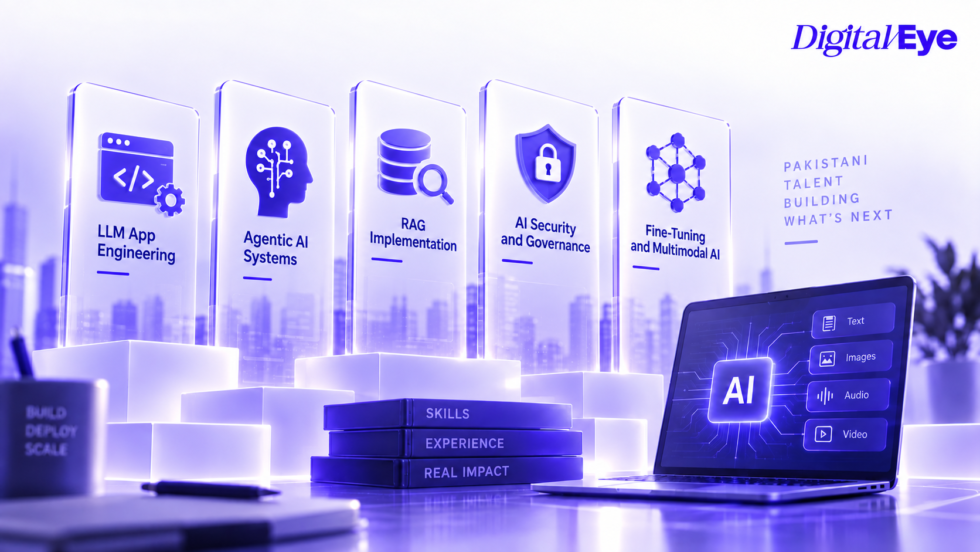
Skill One: Machine Learning Engineering
Machine learning engineering, which encompasses the ability to build, train, evaluate, and productionise AI models, remains the highest-ceiling skill in Pakistan’s technology market. The specific combination the market is paying for is Python fluency alongside practical proficiency in TensorFlow or PyTorch, the two dominant deep learning frameworks, plus experience deploying models at production scale rather than in research or notebook environments.
The distinction between a data scientist who builds models and an ML engineer who deploys and operates them at scale is the distinction the market is most willing to pay to resolve. Companies that have built AI products need engineers who can take a model from a research environment and make it run reliably at the performance and cost targets a commercial product requires. This involves model optimisation, inference latency management, and the operational discipline to maintain a production AI system over time.
Senior ML engineers with this profile, working for international technology companies or product companies on remote contracts, are the professionals reaching the upper end of Pakistan’s AI salary distribution. The skill is learnable, but the production experience that commands the highest rates takes two to three years to build credibly.
Skill Two: MLOps and AI Infrastructure
MLOps, the operational discipline for managing machine learning systems in production, has moved from a specialist niche to a standard enterprise requirement in the past two years. As organisations have accumulated AI models that need to be monitored, updated, retrained, and governed, the engineers who can build and operate the infrastructure those models run on have become disproportionately valuable.
The core technical capabilities in this domain include container orchestration with Kubernetes, model serving infrastructure, CI/CD pipelines adapted for ML workflows, experiment tracking, model versioning, and monitoring for model performance degradation over time. Cloud platform proficiency, specifically with AWS SageMaker, Google Vertex AI, or Azure ML, is standard alongside the ability to build equivalent pipelines on open infrastructure for organisations running on-premise.
For Pakistani IT professionals, MLOps represents a particularly strong opportunity because it sits at the intersection of software engineering, which Pakistan produces at scale, and AI engineering, which is where the premium is concentrated. An experienced software engineer who invests six to twelve months in AI infrastructure skills enters a much smaller competitive pool with a much higher earnings ceiling.
Skill Three: Retrieval-Augmented Generation and Prompt Engineering
The category of skills grouped under retrieval-augmented generation (RAG) and advanced prompt engineering has moved from experimental to commercially central in 2026. Organisations deploying large language models for internal search, customer-facing applications, document processing, and code generation need engineers who understand how to build reliable, accurate AI systems using these techniques.
RAG, in which a language model is grounded in a specific knowledge base or document corpus through a retrieval step rather than relying on its training data alone, is the dominant architecture for enterprise AI applications that require accuracy and up-to-date information. Building a RAG system well requires understanding vector databases, embedding models, chunking strategies, retrieval relevance tuning, and response evaluation.
The reason this category commands a premium is that it is applied and requires production experience. The theoretical understanding of RAG is accessible; making a RAG system that performs reliably at enterprise quality thresholds, handles edge cases gracefully, and can be maintained and updated by a team is harder and rarer. Pakistani engineers who have built production RAG systems for paying clients are competing in a global talent market where that experience is genuinely scarce.
Skill Four: AI Security and Governance
As AI systems move from innovation projects to production infrastructure, the question of how to secure, audit, and govern them has become an enterprise priority. AI security and governance covers a set of capabilities that spans both technical and non-technical skills, making it accessible to professionals coming from compliance, policy, and risk backgrounds as well as from engineering.
The technical side of AI security includes adversarial robustness testing, the detection of prompt injection and model manipulation attacks, data poisoning assessment, and the security review of AI supply chains including third-party models and APIs. The governance side includes AI risk assessment frameworks, model documentation standards, bias and fairness evaluation, and the compliance requirements being established under regulatory frameworks in the EU, UK, and increasingly in Gulf markets where Pakistani IT firms are expanding.
Pakistan’s IT firms serving financial services, government, and healthcare clients in international markets are already encountering AI governance requirements in procurement processes. Engineers who can articulate and implement AI governance frameworks are enabling their firms to win work that competitors without this capability cannot access. This is a skills premium that is defined by market access rather than by technical ceiling alone.
Skill Five: Fine-Tuning and Multimodal AI
The ability to fine-tune pre-trained foundation models on domain-specific data, and to work with multimodal AI systems that process text, images, and structured data in combination, represents the frontier of what enterprise clients are beginning to buy and the next tier of premium capability the market will pay for.
Fine-tuning allows an organisation to adapt a general-purpose foundation model to perform specific tasks with significantly higher accuracy than prompting alone can achieve. For Pakistani IT firms building AI products for sectors with specialised language, terminology, or knowledge, including legal, medical, financial, and technical domains, fine-tuning is often the capability that differentiates a solution from a generic AI integration. The relevant technical skills include dataset curation and preparation, parameter-efficient fine-tuning methods, evaluation benchmark design, and the compute management required to run fine-tuning jobs cost-effectively.
Multimodal AI, which combines language understanding with image analysis, document processing, and structured data interpretation, is moving from research to product in 2026. Engineers who can build applications that work across modalities, for example a system that reads a scanned invoice, extracts structured data, validates it against a database, and generates a structured output, are building the category of AI product that large enterprise clients in Gulf and European markets are currently purchasing.
The return on this skill set is not yet fully priced into the Pakistani market, which means the professionals who build it now are entering the premium tier before competition has compressed the margin.
What This Means for Pakistan’s IT Sector
The five skills above share one characteristic: they require applied experience building systems that real users depend on, not certification. That experience accumulates in Pakistani IT firms, in demanding freelance engagements, and in the AI product companies emerging from Lahore, Karachi, and Islamabad.
Pakistan’s 75,000 annual technology graduates are the raw talent supply. What determines which portion reaches the premium tier is the quality of applied experience available in the first two to three years after graduation. The premium window is real and it is open. The question is how many Pakistani developers walk through it before it narrows.