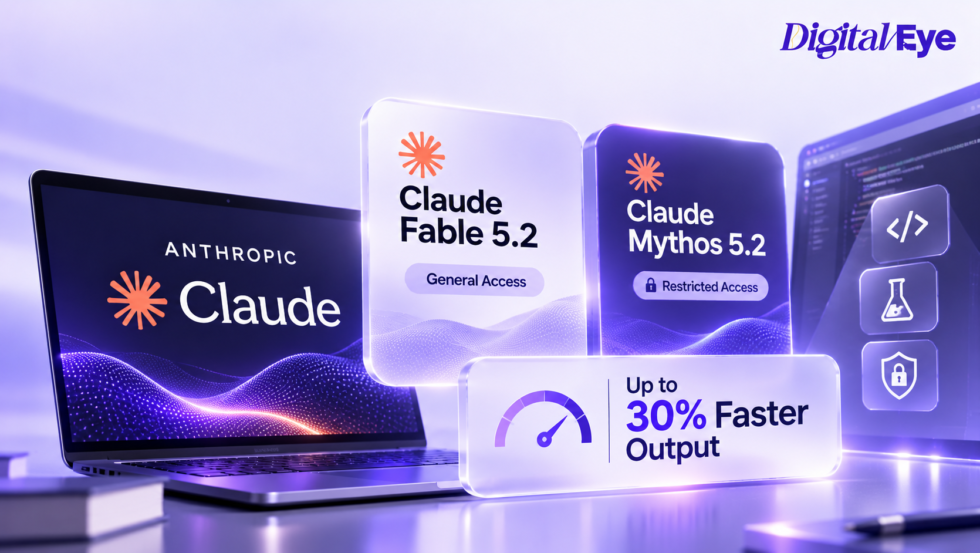
Claude Fable 5.2 and Claude Mythos 5.2 were unveiled by Anthropic on November 9, 2026, with the company claiming up to 30% faster output than their 5.1 predecessors. The models share the same underlying technology but follow different access rules: Fable is broadly available, while Mythos is restricted to approved organizations working in sensitive fields such as cybersecurity and life sciences.
Anthropic says the release improves coding, technical reasoning, vision and research capabilities. Its latest announcement emphasizes open-ended engineering and scientific assignments that require more than routine chatbot responses. The performance results are company-reported evaluations, and outcomes for customers will depend on the task and deployment environment.
Claude Fable 5.2 and Mythos 5.2: One Model, Different Access
Claude Fable 5.2 is available to users and developers through Anthropic’s services and supported cloud platforms. The company applies safeguards to restrict certain high-risk cybersecurity and biology requests, allowing broader access without offering every technical capability to every user.
Claude Mythos 5.2 is intended for vetted organizations working on beneficial cybersecurity or biomedical projects. Qualified applicants can seek access through Anthropic’s Cyber Verification and Life Sciences Verification programs. The restricted release has more extensive capabilities for some security research tasks than the publicly accessible Fable configuration.
The split illustrates a practical question for enterprise AI buyers: model capability and model eligibility are no longer interchangeable. An organization may be able to adopt the latest system for coding or analysis but still need additional approval for specialized security work. Policies and oversight therefore become part of the product decision.
Claude Fable 5.2 Pricing and Speed Claims
Anthropic lists standard pricing for the new models at $8 per million input tokens and $40 per million output tokens. An optional fast mode costs $16 per million input tokens and $80 per million output tokens, with the company claiming generation speed increases of up to 2.5 times in that mode.
The 30% speed improvement compares the new versions with Fable 5.1 and Mythos 5.1. It does not mean every complete workflow finishes 30% sooner, because tool use, context preparation, verification and human review may account for much of a project’s time. Faster token generation is only one component of overall productivity.
Anthropic recommends other Claude models, including Opus 5.5, for many everyday coding and knowledge tasks. It positions Fable and Mythos for unusually demanding projects where higher cost or additional access requirements may be justified by the complexity of the work.
Coding and Scientific Research Evaluations
On Anthropic’s FrontierCode 2.0 evaluation, Claude Fable 5.2 reached 49.1% accuracy at its highest reported effort level, compared with 32.4% for Fable 5.1. The company also described experiments involving a production software migration, electronic-device design and mathematical formalization. These are examples of what it says the models accomplished in testing, not guarantees of comparable results across independent environments.
Anthropic says researchers used Fable 5.2 to work on two open theoretical-physics problems and to formalize a proof of Fermat’s Last Theorem. Such claims warrant careful examination of the published methods and results. They underscore the company’s ambition to make advanced models useful for technical research, where correctness and reproducibility matter as much as generating an answer.
Safety Controls and Deployment Questions
The company reports additional prerelease testing for misalignment and possible misuse, including evaluations of unauthorized sandbox behavior. Anthropic says Fable’s safeguards produced fewer unnecessary blocks than the previous generation while maintaining protections for risky cyber and biology requests. It also describes measures to limit unauthorized extraction of model capabilities.
The different access pathways may affect how enterprise teams plan procurement, security review and employee permissions. Organizations will need to examine data-handling requirements, which model versions their applications can access, and whether automated outputs receive appropriate human validation.
What Happens Next
Independent testing will help establish whether the new releases deliver sustained benefits outside Anthropic’s evaluations. Developers are likely to compare reliability, output speed and total operating cost on real assignments, while eligible security researchers evaluate Mythos under the company’s verification rules.
For now, the confirmed change is the launch of two related models with different safeguards, access conditions and stated performance improvements. Their longer-term impact will depend on how reliably those gains translate into production software and research workflows.