
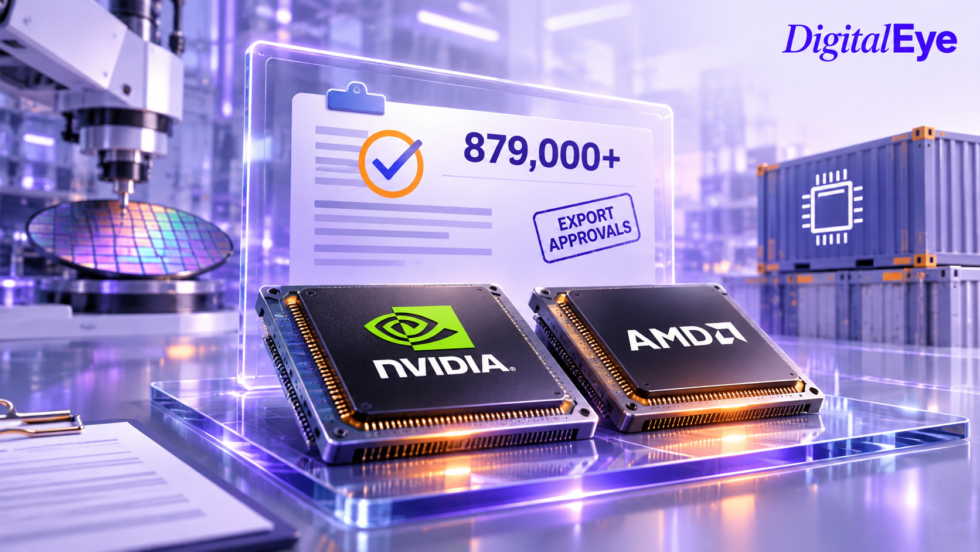
The US House Foreign Affairs Committee released information on November 19, 2026 showing that federal regulators approved export licenses covering more than 879,000 advanced Nvidia and AMD AI chips for Chinese customers. The approvals were among requests covering about 3.4 million chips, according to the committee’s public statement. The disclosure provides new detail about the scale of the China-related licensing decisions, but an approved license does not mean every chip was exported.
The released information concerns applications to the US Commerce Department’s Bureau of Industry and Security between December 2025 and May 2026. It includes H200-class Nvidia hardware and AMD processors, both important to high-performance artificial intelligence systems. Congressional leaders released the records as scrutiny intensified over how sensitive computing technology is licensed for international markets.
What Nvidia and AMD AI Chip Approvals Actually Show
The committee said requests covered approximately 3.4 million advanced AI chips, while approvals exceeded 879,000. Those quantities describe a regulatory process rather than confirmed factory output, customs shipments or chips operating inside Chinese data centers. The difference matters because a license can be issued without the recipient taking delivery of all the approved hardware.
The committee also identified approvals involving Chinese companies it characterized as linked to US national-security concerns. Those descriptions reflect the committee’s release and should not be stretched into claims that every listed transaction violated the law. The publicly disclosed documents provide a basis for further examination of license recipients, quantities and permitted destinations.
Why Nvidia and AMD Are Central to the Debate
High-performance GPUs have become essential to training and serving large AI models. Restrictions on access affect how companies plan data-center construction and compete for scarce processing capacity. Nvidia and AMD therefore sit at the center of a policy debate that combines trade, industrial competitiveness and national security.
Permission to ship selected products has changed over time. Companies must navigate both American export rules and restrictions or commercial decisions in the importing country. Regulatory permission is only one part of a commercial transaction. Production commitments, delivery schedules and the willingness of buyers to proceed can all affect whether licensed products are actually delivered.
How the Disclosure Changes the Story
The committee’s decision to make licensing information public allows policymakers and industry observers to examine the volume of applications and approvals with more precision than was possible from broad public statements. It also creates a benchmark against which subsequent export-control changes can be assessed.
The records do not independently establish how many approved chips crossed the border. That distinction is especially important amid separate reporting that Nvidia had stopped shipping some previously authorized Hopper-generation chips to China. Those developments may appear contradictory, but they refer to different parts of the export process: a past license approval and a later decision or restriction affecting shipments.
Investors may also read the figures differently from security officials. For chipmakers, approvals can indicate potential access to a significant market. For policymakers, the same figures raise questions about the safeguards attached to sales and their implementation. Neither interpretation settles the actual volume shipped or the ultimate use of every device.
What Happens Next
Further scrutiny will center on the released license files, the conditions attached to approvals and evidence of completed deliveries. Lawmakers may seek additional records or propose changes to the way export controls are reviewed and enforced. Nvidia and AMD will continue making commercial decisions under applicable rules, while Chinese customers evaluate alternative sources of AI computing capacity.
The confirmed development is the November 19 public disclosure of more than 879,000 approved chips. It is not evidence that all of those chips have arrived in China. That difference should remain visible in every headline, chart and social media summary of the story.