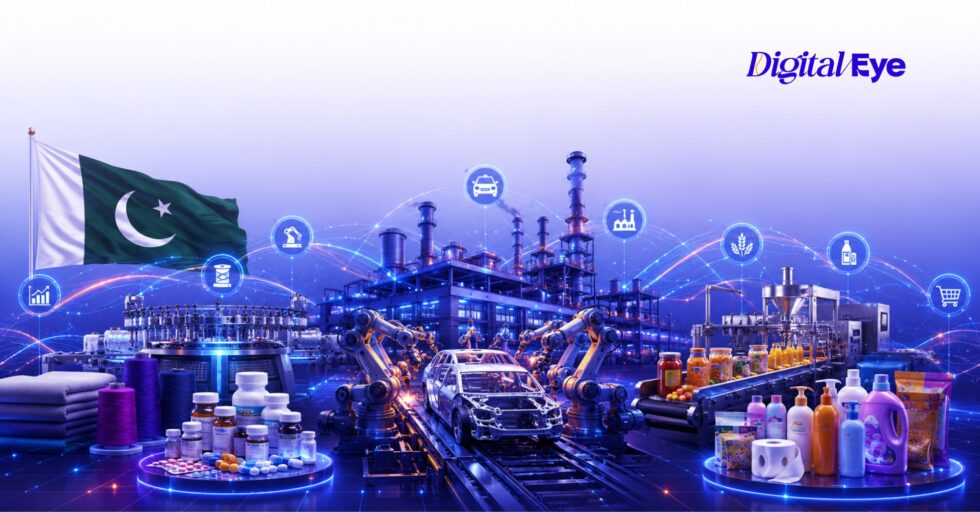
Pakistan’s large-scale manufacturing (LSM) grew 6.48% in the first nine months of FY2025-26, the strongest performance in four years. Growth was recorded in 16 of 22 tracked industrial sectors. The automobile sector led with a 61% surge. The economy expanded 3.7% for the full year, falling short of the government’s 4.2% target but recovering measurably from the contraction years of 2022-23.
The aggregate numbers are encouraging. The sector-by-sector picture is more complicated. Pakistan’s four largest manufacturing categories, textiles, pharmaceuticals, automotive, and food processing, are each at a different stage of development, facing different constraints, and moving in different directions. What follows is an honest assessment of where each stands in mid-2026.
Textiles: Growth Numbers That Mask a Structural Threat
Exports hit $17.85 billion in eleven months of 2025. The next three years will test whether that momentum survives two simultaneous shocks.
Textiles remain the backbone of Pakistan’s manufacturing economy, accounting for approximately 60% of total national exports and employing millions directly and indirectly across the value chain. Export figures for 2025 were strong: $17.85 billion in the first eleven months of the year, up 16% year-on-year. The growth was partly value-driven, reflecting higher prices and cost pass-throughs, but the headline number is real and sustains Pakistan’s position as a globally competitive textile exporter.
The challenge is what is building on the horizon.
The European Union’s Carbon Border Adjustment Mechanism entered its definitive phase on January 1, 2026. CBAM currently applies to steel, cement, aluminium, fertilisers, electricity, and hydrogen. Its expansion to textiles and apparel is scheduled for the 2026-2030 window. When that expansion arrives, Pakistani textile exporters selling into the EU, which accounted for 75.8% of Pakistan’s EU exports in 2024, will face carbon pricing on the embedded emissions of their products. Pakistan’s energy mix, still heavily reliant on fossil fuels, means the carbon content of textile production is not yet competitive with exporters from countries with greener grids or established carbon accounting infrastructure.
Simultaneously, renewed US trade measures are redirecting Chinese textile production away from North America and into European markets, where it competes directly with Pakistani garments. Buyers in Germany, France, and the Netherlands who shifted to Pakistan from China during the previous US-China trade friction are now being re-approached by Chinese suppliers at lower prices.
Pakistan currently holds GSP+ status with the EU, which provides preferential tariff access and has been a material contributor to textile export competitiveness. The conditions attached to GSP+ include human rights and governance benchmarks. The renewal trajectory for the next decade involves scrutiny that has become more, not less, intensive.
The sector’s domestic constraints are long-standing: energy costs and reliability, absence of a comprehensive national textile policy, and limited upstream investment in yarn and fibre production that would allow greater value-added capture. The EU’s incoming Digital Product Passport requirement, which will mandate transparent supply chain data for textiles sold in the EU market, adds a compliance layer that Pakistan’s mills are only beginning to prepare for.
The verdict: textiles are growing now, but the regulatory and competitive environment of the next three years will require investment in sustainability compliance and supply chain transparency that most Pakistani mills have not yet budgeted for.
Pharmaceuticals: A Billion-Dollar Industry Aiming for Ten, Held Back by One Structural Flaw
Exports grew 34% in FY25, the best performance in twenty years. The $30 billion target is real. So is the 90% API import dependency.
Pakistan’s pharmaceutical sector crossed Rs1 trillion in annual market value by end-2025, making it one of the largest industrial segments in the country. The industry produces more than 90% of the country’s medicines domestically, covering generics, APIs, syrups, injectables, and over-the-counter products. Exports grew 34% in FY25 to $457 million, the highest growth rate in two decades. Pakistani firms are expanding into Africa, Central Asia, Southeast Asia, and parts of the Middle East, and the Health Ministry has set a $30 billion export target over the next five years.
The target is ambitious but not implausible in direction, if not in specific number. Pakistan’s pharmaceutical competitive advantages are real: low-cost manufacturing, an established domestic generics industry, and a large and growing pool of qualified chemists and pharmaceutical technicians. The Halal pharmaceutical segment, covering medicines, supplements, and healthcare products produced under Islamic compliance standards, is a growing global niche where Pakistan holds structural credibility.
The sector’s most significant structural constraint is straightforward: approximately 90% of Active Pharmaceutical Ingredients are imported, primarily from China and India. API dependency means that cost volatility in raw materials, which tracks closely with global energy prices and supply chain conditions in China, directly compresses margins that are already constrained by government price controls. The Drug Regulatory Authority of Pakistan controls medicine pricing, which protects affordability for domestic consumers but limits the profitability that would otherwise incentivise investment in research, quality infrastructure, and the regulatory certifications required to sell into high-value markets like the EU and United States.
Accessing regulated markets, where margins are substantially higher, requires WHO Good Manufacturing Practice certification and, for the EU and US, local regulatory approvals that take years and significant capital to obtain. Pakistani firms have historically been concentrated in less-regulated export markets precisely because the cost of regulatory compliance for high-value markets has exceeded their capacity.
The verdict: Pakistan’s pharmaceutical sector has genuine export momentum and a credible directional growth story. Getting from $457 million to anything approaching $30 billion in exports requires solving the API dependency problem and building the regulatory infrastructure to access high-margin markets. Neither is a quick fix.
Automotive: The Sector That Surprised Everyone, and What Comes Next
A 61% surge in LSM output, BYD entering local assembly, and a government EV target. Pakistan’s automotive sector is genuinely changing.
The automotive sector was the standout performer in Pakistan’s manufacturing data for FY26, with LSM output up 61% in the first nine months of the year. This is not a statistical anomaly. It reflects the convergence of pent-up demand from the recessionary years of 2022-23, tariff reforms that have made new vehicle categories more accessible, and a structural shift in the competitive landscape of Pakistan’s car market.
For most of Pakistan’s automotive history, the market was controlled by three established players (Toyota, Honda, Suzuki) operating through local assembly partners with limited competition and pricing power that sat firmly with manufacturers rather than consumers. That dynamic is changing. New entrants from China, South Korea, and Europe have introduced models across multiple price points. Consumers are evaluating features, warranty terms, and long-term ownership costs rather than simply accepting the available options. The market has begun to function more like a competitive consumer market.
The most consequential development for the next twelve months is BYD’s planned entry into local assembly. BYD, the world’s largest electric vehicle manufacturer by volume, is scheduled to begin Pakistan operations in July-August 2026 with a $150 million investment and initial annual capacity of 25,000 units. Chery has already begun CKD (completely knocked down) production at a new Port Qasim facility in Karachi, starting with hybrid variants of the Tiggo series. The government has set a target of electric vehicles comprising 30% of car sales within five years, supported by lower import duties on parts and equipment and preferential electricity tariffs at charging stations.
The EV transition in Pakistan faces infrastructure constraints that the target does not resolve: charging networks outside major urban centres are minimal, grid reliability affects the practical case for EV ownership outside Karachi, Lahore, and Islamabad, and consumer financing for vehicles at EV price points remains limited. BYD’s entry will test whether Pakistani consumers are willing to adopt EVs at scale when the infrastructure and financing conditions improve incrementally rather than all at once.
The verdict: Pakistan’s automotive sector is in genuine structural transition, with the strongest output growth of any manufacturing category and a credible pipeline of new entrants and EV investment. The 30% EV target is aspirational; the progress toward it will be infrastructure-constrained rather than demand-constrained.
Food Processing and FMCG: The Sector Most Under-Leveraging Its Own Raw Material Base
The second-largest manufacturing sector by value-added contribution. Forty percent of Pakistan’s agricultural produce is lost before it reaches processing. That gap is the opportunity.
Pakistan’s food and beverage processing industry is the second-largest industrial sector after textiles, contributing 27% of value-added manufacturing output and 16% of manufacturing sector employment. Packaged food sales were projected at PKR 1,311 billion for 2025, driven by rising urban incomes, younger consumer demographics, and growing preference for processed and convenience food formats.
The sector’s headline challenge is post-harvest loss. An estimated 40% of Pakistan’s agricultural produce is lost before reaching processing facilities, due to inadequate cold-chain infrastructure, poor storage facilities at farm gate, and transportation networks that were not designed around food logistics. For a country that is among the world’s largest producers of wheat, rice, sugarcane, mango, and citrus fruit, the gap between agricultural output and processed food exports is one of the most significant undercaptured economic opportunities in the industrial economy.
The global Halal food market, which Pakistan is structurally positioned to serve, was estimated at $2.5 trillion in 2024 (GM Insights) and is projected to grow further through 2026 and beyond. Pakistan’s share of that market remains disproportionately small relative to its agricultural base, production capacity, and Muslim-majority status. The reasons are consistent: quality standardisation, packaging and shelf-life technology, food safety certification (particularly for EU and US markets), and cold-chain logistics that would allow perishable processed products to reach export markets competitively.
Domestic FMCG companies, including Nestlé Pakistan, Unilever Pakistan, and a growing number of local brands, have invested in production modernisation and are growing revenues at double-digit rates in the domestic market. The export story is underdeveloped. Poultry processing grew approximately 10% in FY24, and there is growing interest from Gulf Cooperation Council markets, particularly Saudi Arabia and the UAE, in Pakistani processed food products. Converting that interest into consistent, certified, and competitively priced export supply remains the challenge.
The verdict: food processing is Pakistan’s most underdeveloped manufacturing opportunity relative to its raw material base. The investment required (cold-chain infrastructure, food safety certification, processing technology) is capital-intensive and not primarily addressable through policy alone. Private sector investment in integrated agri-processing facilities, supported by export-oriented incentives, is what would move this sector.
What This Means: The Manufacturing Economy at a Fork in the Road
Pakistan’s manufacturing recovery in FY26 is real. LSM growth at 6.48% over nine months, automobile output up 61%, pharmaceuticals posting export growth unseen in twenty years, and broad-based expansion across 16 sectors are evidence of an economy stabilising after severe macroeconomic stress.
But the recovery is concentrated in sectors where demand was suppressed rather than structurally transformed. Automotive growth reflects pent-up consumer demand returning as inflation eased and financing became more accessible. Textile growth reflects price effects as much as volume gains. The structural questions, how Pakistan textile mills will handle CBAM compliance, whether the pharmaceutical sector can reduce API dependency, whether EV infrastructure can keep pace with EV ambitions, and whether food processing can finally unlock the cold-chain investment it has needed for a decade, remain open.
Pakistan’s manufacturing economy in 2026 is growing, but it is growing toward a set of external pressures, climate regulations in Europe, Chinese manufacturing competition, raw material import dependency, and infrastructure gaps, that its current industrial policy is not yet fully designed to address. The next budget cycle’s manufacturing commitments will be the clearest signal of whether this recovery is being sustained by design or by deferred reckoning.