
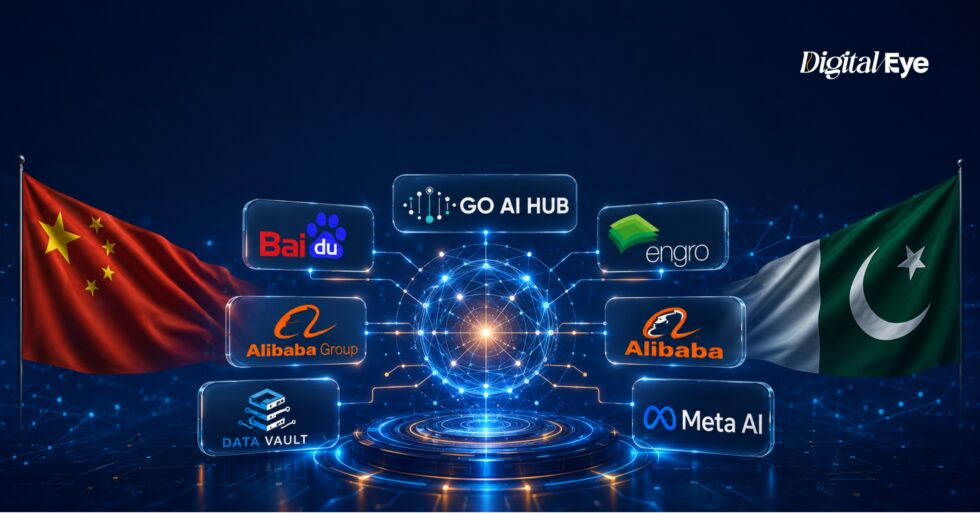
Pakistan signed more artificial intelligence and technology agreements in 2025 and the first half of 2026 than in the previous five years combined. The pace reflects a shift in how the country is positioning itself: less as a cheap outsourcing destination, more as a market for AI infrastructure, talent pipelines, and regional technology partnerships. The signings have ranged from government-to-government frameworks to conglomerate-level bilateral deals, with implications for skills development, sovereign computing, and industrial AI adoption.
Not all MoUs become operational programs. But the pattern of who Pakistan is partnering with, and on what terms, maps the direction of the country’s digital economy for the next decade. Here is the comprehensive list, ordered chronologically.
GO AI Hub | Pakistan-Saudi Arabia | 2025
AI innovation hub in Islamabad anchoring the Gulf-Pakistan technology corridor
The Government Outcomes AI Hub was inaugurated in 2025 in Islamabad as the flagship initiative of Pakistan’s AI partnership with Saudi Arabia. The Hub is designed to serve as a centre for advanced AI research, industry-grade AI solution development, and talent development with direct market linkage to the Gulf Cooperation Council. It positions Pakistan as a supplier of AI-enabled human capital for Saudi Arabia’s Vision 2030 digitalisation programmes, at a time when Saudi Arabia faces a documented shortage of 663,000 ICT workers. The Hub is one of the clearest examples of Pakistan converting a bilateral relationship into a structured technology-services pipeline, with Islamabad as the production base and Riyadh as the primary market.
Meta Urdu AI | Meta / Ministry of IT | 2025
Meta AI launched in Urdu, making Pakistan one of the first markets to get local-language AI access
In 2025, Meta partnered with Pakistan’s Ministry of Information Technology and Telecommunication to launch the Urdu version of Meta AI, enabling interaction in Pakistan’s national language through WhatsApp, Instagram, Facebook, and Meta’s standalone AI interface. The collaboration made Pakistan among the first countries globally to receive a local-language version of Meta’s AI assistant, giving tens of millions of Urdu speakers access to a conversational AI tool in their primary language. The partnership’s significance extends beyond the consumer product: it establishes a government-Meta working relationship for AI localisation that could be extended to education, healthcare information, and public services.
SkillTech Pakistan | Government of Pakistan / Huawei / ZTE | September 2025
430,000 advanced digital skills trainings targeting the AI and 5G workforce gap
Launched in September 2025, SkillTech Pakistan is a three-year, government-led initiative to deliver 430,000 advanced digital skills trainings across six flagship programmes. The initiative includes strategic partnerships with Huawei and ZTE for AI, 5G, and cloud training content and certification infrastructure. The scale of the programme reflects an explicit acknowledgment that Pakistan’s IT export growth (21% year-on-year in FY26) is currently supply-constrained: the talent pipeline does not yet produce enough engineers trained in the technologies that global enterprise clients are procuring. SkillTech is designed to close that gap, with Huawei and ZTE providing curriculum and certifications that are globally recognised in Asian and Middle Eastern markets.
Supreme Court of Pakistan / Supreme People’s Court of China | August 2025
Judicial AI cooperation and technology exchange between Pakistan and China’s court systems
In August 2025, the Supreme Court of Pakistan and the Supreme People’s Court of China signed a Memorandum of Understanding establishing a framework for judicial exchanges, technology cooperation, and capacity building in emerging legal areas. The agreement includes AI-related cooperation, covering how both court systems deploy technology for case management, document processing, and legal research. China’s court system has been among the more advanced globally in integrating AI into judicial operations, and the MoU gives Pakistan’s judiciary structured access to that experience. The practical applications being explored include AI-assisted case triage, automated legal document review, and digital court infrastructure.
Data Vault Pakistan / CoE AITeC | Sovereign AI MoU | December 2025
Pakistan’s first structured sovereign AI and high-performance computing partnership
In December 2025, Data Vault Pakistan and the Centre of Excellence Artificial Intelligence Technology Centre (CoE AITeC) at the National Centre for Physics signed a strategic MoU to accelerate Pakistan’s sovereign artificial intelligence, high-performance computing, and advanced research capabilities. The agreement is notable for its focus on sovereignty: the explicit goal is to build AI computing infrastructure that Pakistan owns and controls, rather than relying on foreign cloud platforms for critical national AI processing. The Centre of Excellence AI Technology Centre, housed at the National Centre for Physics in Islamabad, provides the research institution anchor for what is intended to become a national AI computing base.
Pakistan-China 24 Tech MoUs | Joint Working Group on IT Cooperation | December 2025
24 bilateral agreements establishing a digital corridor under CPEC Phase 2
Pakistan and China signed 24 Memoranda of Understanding under the Joint Working Group on IT Cooperation, the formal bilateral IT body established under CPEC Phase 2. The agreements collectively aim to expand collaboration across ICT infrastructure, cybersecurity, emerging technologies, and human resource development. Specific initiatives within the bundle include large-scale digital skills training programmes with Huawei, Google, and ZTE, and AI collaboration frameworks involving the Asian Development Bank and Pakistan’s Ignite National Technology Fund. The scope is deliberately broad: the 24-MoU framework functions as an umbrella under which specific programmes are activated as funding and implementation capacity allows.
Pakistan-China Quantum Technology | CETC / National Centre for Quantum Computing | October 2025
China Electronics Technology Group Corporation commits to building Pakistan’s quantum computing centre
Pakistan and China signed a memorandum of understanding to collaborate on quantum technologies under CPEC’s second phase. China Electronics Technology Group Corporation (CETC), one of China’s largest state-owned defence and electronics conglomerates, committed to supporting the establishment of Pakistan’s National Centre for Quantum Computing. The partnership is significant both for its technical scope (quantum computing infrastructure remains rare in the developing world) and for its strategic dimensions (CETC’s involvement places Pakistan’s quantum programme within China’s broader national quantum strategy). The National Centre for Quantum Computing is intended to serve as a research hub for Pakistani scientists while providing China with a regional testbed for quantum infrastructure deployment.
Government of Pakistan / Alibaba Group | May 2026
Multi-sector AI and digital economy MoUs signed in Hangzhou with PM Shehbaz Sharif in attendance
The Government of Pakistan and Alibaba Group signed a cluster of strategic MoUs in May 2026 at Alibaba’s headquarters in Hangzhou, witnessed personally by Prime Minister Shehbaz Sharif and Alibaba Group Chairman Joe Tsai. The agreements span artificial intelligence, cloud computing, healthcare technology, e-commerce, SME development, and digital financial services. The flagship AI commitment involves Ignite National Technology Fund and Alibaba Cloud collaborating to develop localised AI and cloud solutions, including AI foundation models trained on Urdu and regional languages for education, healthcare, and agriculture. A parallel skills initiative targets 500,000 individuals, including developers, students, and public sector employees, for AI and cloud training. In healthcare, DAMO Academy and Sky47 are deploying AI-enabled multi-disease screening technology using non-contrast CT scan analysis. The Alibaba MoUs are the largest single cluster of AI-specific agreements Pakistan has signed with any global tech company.
Engro / Baidu | June 2026
Pakistan’s largest conglomerate partners with China’s leading AI lab for industrial AI adoption
Engro Corporation, Pakistan’s most diversified conglomerate with operations across energy, fertiliser, food, and digital infrastructure, signed a Memorandum of Understanding with Baidu in June 2026 to explore AI capabilities and ecosystem development across the region. The partnership is structured around Baidu’s PaddlePaddle deep learning framework, with three initial focus areas: Industrial Research Centres housing a full AI stack for localised research and development, Intelligent Industry Workshops applying AI across industrial and manufacturing value chains, and Talent and Innovation Training through MIIT-certified AI education programmes. Engro’s scale as a conglomerate gives the partnership a direct pathway into Pakistan’s industrial sector, which is otherwise underserved by most AI partnerships that focus on the IT services or government segments.
What This Means
The pattern across Pakistan’s 2025-2026 AI partnership activity is consistent: China is the dominant partner by volume and scope (Alibaba, Baidu, Huawei, ZTE, CETC, 24 bilateral MoUs), with Saudi Arabia providing the most commercially specific market-access opportunity through the GO AI Hub. Meta represents a meaningful Western technology company engagement, though focused on consumer and language rather than infrastructure.
What most of these agreements share is a focus on talent scale and localised AI, rather than immediate product deployment. The skill development commitments (500,000 through Alibaba, 430,000 through SkillTech, HPC capability through CoE AITeC) collectively represent the largest coordinated investment in Pakistan’s digital human capital since the country’s IT sector began. The Engro-Baidu partnership is the most commercially interesting for Pakistan’s industrial economy because it targets the manufacturing sector, which is where AI adoption would have the broadest productivity impact. Whether these MoUs convert into operational programmes at the scale promised is the question that will define Pakistan’s AI standing by 2028.