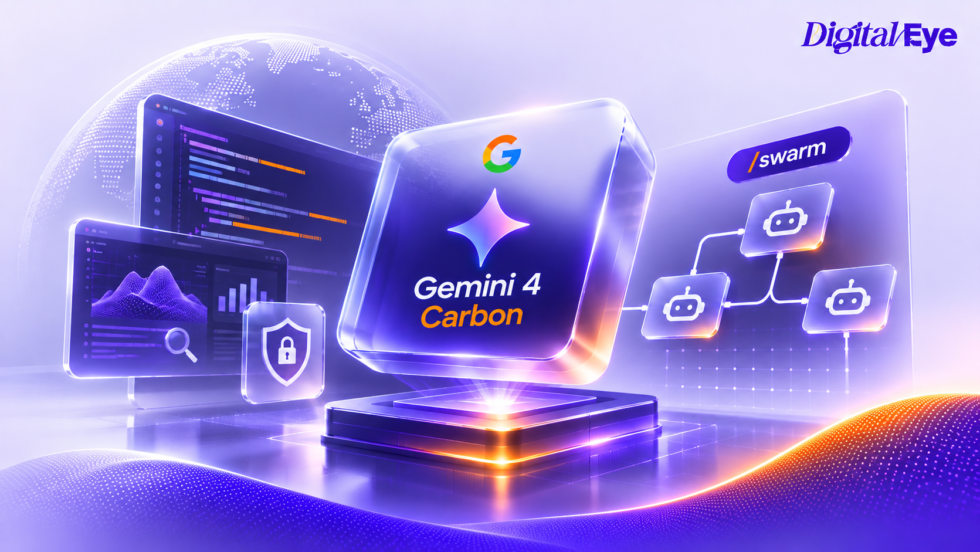
Gemini 4 Carbon became available to developers, enterprises, researchers and eligible consumers on November 10, 2026, as Google’s latest frontier artificial intelligence model. The company is also previewing a multi-agent feature called /swarm in Google Antigravity, designed to coordinate several AI workers on long-running coding and research assignments.
Google positions Carbon above Gemini 4 Argon for difficult software engineering, scientific investigation and cybersecurity reasoning. Argon remains the company’s recommended option for many routine knowledge and development tasks, while Carbon uses longer reasoning and verification processes for problems that demand more exploration.
Gemini 4 Carbon Adds Long-Horizon Agent Capabilities
Google says the model can undertake complex, multistep software projects, work with large collections of business documents and generate structured research outputs. Its announcement describes benchmark results in coding, automation and financial analysis, but those claims do not establish that every customer will achieve similar results in production.
A major addition is the Antigravity /swarm preview. Instead of assigning one assistant a single sequence of tasks, developers can coordinate separate agents for system architecture, implementation, review and verification. Some workers can use Carbon for deeper reasoning while others rely on faster models for routine subtasks.
The system aims to reduce the amount of manual switching and coordination required during prolonged engineering projects. However, parallel agents introduce practical issues around access permissions, conflicting edits, testing and accountability. Human review remains important when automated changes affect deployed software.
Google Antigravity Swarm Is a Preview, Not a Universal Feature
Google demonstrates /swarm through prototypes ranging from interactive three-dimensional experiences to complex models built from engineering drawings. These examples illustrate intended uses and are not independent guarantees about delivery time, reliability or deployment quality.
The company says the preview allows developers to track agents in real time and use isolated workspaces, including adversarial verification steps. Availability and usage limits vary by product and subscription, so customers should confirm the specific terms before planning production work around the feature.
The official Gemini 4 Carbon announcement also highlights experiments in complex financial research, document analysis and cybersecurity. Google reports that Carbon performed strongly on selected evaluations and was more economical per task than certain competing configurations. These are benchmark-specific findings rather than universal price comparisons.
Gemini 4 Carbon Pricing and Availability
Gemini 4 Carbon is offered through the paid Gemini API tier in Google AI Studio and through Gemini for business. Google AI Ultra subscribers can access it in supported experiences including the Gemini app, Antigravity and AI Mode in Search. Researchers may apply for a limited access program subject to eligibility and capacity.
The company lists an introductory API price of $2 per million input tokens and $10 per million output tokens for the public Carbon model. Google says this introductory rate lasts through November 30, 2026; afterward, the stated price rises to $4 for input and $20 for output per million tokens.
That planned increase matters for organizations comparing long-running workflows. Agentic systems can generate substantial token usage through repeated planning, tool calls and verification. The price per token is only one part of the final cost, which also depends on errors, retries, latency and required oversight.
Cybersecurity Access Has Additional Conditions
Google previously made Carbon available to selected cybersecurity defenders through its Fairwind Program. The broader launch does not mean every advanced cyber capability is unrestricted. The company directs qualified defenders to apply through the relevant program and says it conducts automated red-teaming and safety evaluations.
Enterprises deploying Carbon must still decide which corporate systems their agents can access and what actions require approval. Better reasoning does not automatically grant an AI assistant authority to inspect confidential records or modify critical services.
What Happens Next
Developers will evaluate whether Carbon and the new multi-agent tools improve task completion on real projects, compared with simpler models and conventional workflows. Google’s announced API price change at the end of November also gives buyers a near-term point to reassess costs.
The confirmed development is wider Carbon availability alongside an Antigravity swarm preview. The longer-term impact will depend on independent performance testing, enterprise security controls and reliable results outside staged demonstrations.