
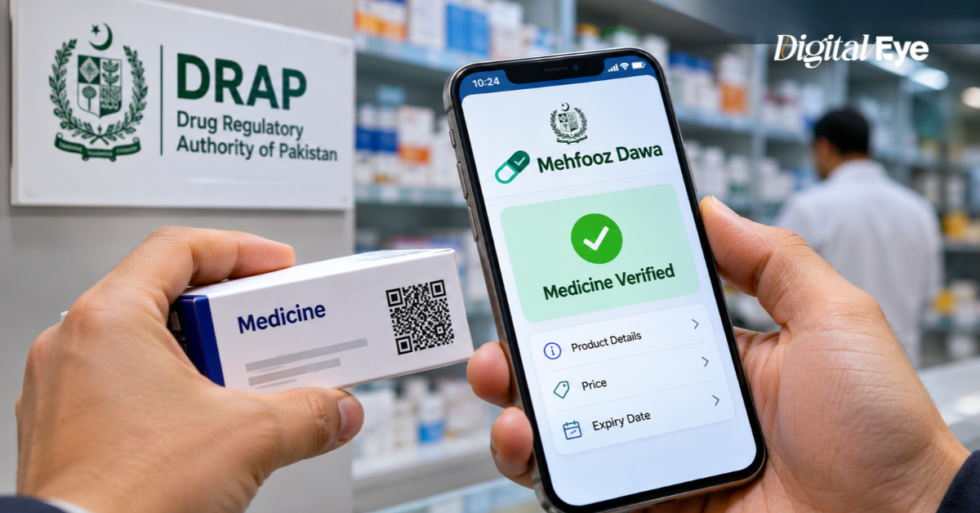
Pakistan has formally launched the Mehfooz Dawa app, a mobile service designed to help people check medicines before purchasing or using them. Prime Minister of Pakistan inaugurated the application in Islamabad on November 26, 2026, describing medicine verification as a public-health priority. The Ministry of National Health Services developed the initiative with the Drug Regulatory Authority of Pakistan (DRAP). Officials said a database covering approximately 92,000 pharmaceutical products supports the system.
How the Mehfooz Dawa App Checks Medicines
The Mehfooz Dawa app lets consumers scan the two-dimensional barcode on a medicine package and compare its information with regulatory records. The system is designed to show whether the scanned medicine matches the record, alongside relevant product information. Public statements from DRAP indicate that customers can check authenticity, pricing and expiry details. At the launch, officials described a green verification display for a recognized genuine medicine and a red warning for a product flagged as counterfeit.
The application also includes options to submit complaints and report shortages, according to launch coverage. Those features could help people alert regulators about questionable medicine supplies or availability problems. Users should follow the application’s instructions and report suspicious results rather than assuming an unfamiliar barcode automatically proves an offense by a pharmacy or manufacturer.
92,000 Pharmaceutical Products in the Database
Health Minister Mustafa Kamal told the launch audience that the pharmaceutical industry had helped establish a database containing 92,000 products. The figure describes the reported product records, not 92,000 verified pharmacies or evidence that every medicine package sold across Pakistan has been checked. The effectiveness of the service will depend on accurate records, properly printed codes and cooperation from manufacturers, distributors and retailers.
The system also builds on regulatory work that began before the formal inauguration. DRAP said its centralized pharmaceutical track-and-trace arrangements became operational on October 9, 2026, and it encouraged consumers to use the verification application earlier in November. Therefore, November 26 is the date of the prime minister’s official launch ceremony, not necessarily the first day any tracking functionality existed.
Why Pakistan Is Using Barcodes Against Counterfeit Drugs
Counterfeit and substandard medicines can place patients at risk because a product’s packaging may not reflect its actual contents, quality or origin. A searchable regulatory database gives customers another way to check identifying information at the point of purchase. It can also help regulators identify irregularities when reports are received from different locations. However, a successful barcode lookup is not a laboratory test of the medicine inside a package.
For that reason, consumers should continue to use reputable pharmacies, inspect expiry information and seek professional guidance if a medicine seems suspicious. A copied or damaged code can create complications that a simple scan may not fully resolve. The app should be understood as an additional verification tool within pharmaceutical oversight, not a guarantee that a particular dose is clinically safe.
Government Plans Public Awareness Campaign
During the ceremony, the prime minister directed the health ministry to coordinate with information and technology authorities to raise awareness so more households can benefit. DRAP’s chief executive said regulatory procedures had been digitized. The government also linked the initiative with broader concerns about medicine affordability and access, although the application itself does not set prices or replace the country’s medicines regulation system.
What This Means
The immediate change is that Pakistan has publicly launched a consumer-facing channel for checking medicine data. The next measures of success will be whether users can easily access it, whether product records remain current and whether reports lead to appropriate regulatory action. A 92,000-product database creates a starting point, but public trust will depend on accurate verification, effective follow-up and clear communication when a scan raises concerns.