Pakistan’s technology sector has a well-documented talent export problem. The country produces world-class engineers who build global products from Karachi and Lahore, typically for companies headquartered elsewhere. It produces services firms that execute brilliantly for Fortune 500 clients. What it has struggled to produce, with one significant exception, is a Pakistani product that competes globally on its own terms.
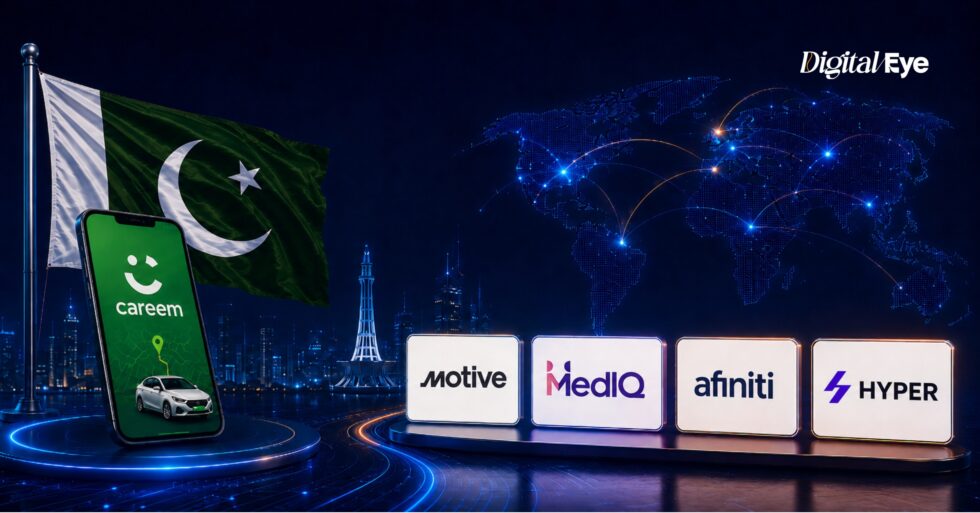
That exception is Careem. Founded in Dubai by Pakistani co-founder Magnus Olsson alongside Mudassir Sheikha, Careem built a ride-hailing and super-app platform that became the dominant player across the Middle East, North Africa, and Pakistan before Uber acquired it for $3.1 billion in 2020. The lesson Careem demonstrated was not simply that Pakistani founders can scale globally. It was that a product built for markets with similar infrastructure constraints, high mobile penetration, an underserved financial layer, and fragmented incumbent alternatives can win in ways that Western products cannot replicate easily.
That template is now being applied, consciously or not, by a new cohort of Pakistani products. Some have already crossed into genuine global scale. Others are positioned to follow. Here is an honest assessment of both.
The Benchmark: Products That Have Already Proved It
Before examining what is emerging, it is worth establishing that global-scale Pakistani products already exist. They are simply undercelebrated within the ecosystem.
Motive — $549M ARR, NYSE IPO Filing, 2026
Originally founded as KeepTruckin by Pakistani-American founder Shoaib Makani, Motive has evolved into one of the leading fleet and physical operations management platforms in the United States. The company crossed $549 million in annual recurring revenue in 2025 with a $2.9 billion valuation and filed for an IPO on the New York Stock Exchange in late 2025 under the ticker MTVE. It employs approximately 3,200 people in Pakistan, making it one of the single largest employers of Pakistani tech talent globally.
Motive’s product combines vehicle telemetry, AI dashcam analytics, predictive maintenance, and safety automation for fleet operators across trucking, construction, agriculture, and energy. The global competitiveness is straightforward: it is a category leader in a $50 billion+ addressable market, competing directly with Samsara on product and price. Pakistan built a significant portion of it.
NetSol Technologies — 40+ Countries, NASDAQ Listed, $73M Revenue
NetSol has been quietly global for four decades. Listed on NASDAQ and headquartered in Calabasas, California, the company builds asset finance and automotive digital retail software serving leasing companies, banks, and automotive OEMs across more than 40 countries. In fiscal 2026, the company is tracking $73-74 million in revenue, with active pilots at US BMW dealerships across 350 locations.
Its Transcend platform suite covers the complete asset lifecycle from retail sale through financing and leasing. NetSol is not a fast-growth startup story but a durable product business that has found a niche where Pakistani engineering costs and deep domain expertise combine to create a defensible competitive position.
Afiniti — Global Contact Center AI
Afiniti’s behavioural pairing technology, which uses reinforcement learning to match callers with optimal contact center agents, is deployed at major telcos, banks, insurers, and healthcare providers globally. The company was founded by Pakistani-American entrepreneur Zia Chishti. PTCL was the first company to go live with Afiniti at scale in Pakistan, but the deployments that matter commercially are the ones at global carriers and financial institutions. Afiniti represents a product built on a genuinely differentiated AI thesis, not a localisation play.
The Next Wave: Products Engineered for Global Reach
These are not companies that might eventually become global. They are companies whose fundamental product design assumes a global market from the start.
Hyper by CodeNinja — Composable AI Coding Platform
Hyper is a composable AI coding platform that enables enterprise teams to build internal applications without deep development overhead. It generates backend schemas and business logic, while a Co-Pilot guides service interface design for MCP-enabled applications. AI coding assistants like Claude Code or Cursor complete the last-mile development layer.
The global competitive thesis rests on timing. Gartner projects that rapid application development platforms will account for 70 percent of new enterprise software development by 2025. Most incumbents in this space, such as OutSystems, Mendix, and Appian, were built before the AI-native coding era and are now retro-fitting AI onto legacy low-code architectures. Hyper is built around AI agents as first-class citizens from the ground up. CodeNinja’s existing relationships with Fortune 500 clients in North America and the Middle East provide the distribution channel that most emerging-market product companies lack entirely.
Uplift AI — Voice Infrastructure for Underrepresented Languages
Uplift AI is not building another voice assistant. It is building foundational voice technology for the languages that global AI labs have deliberately ignored because the addressable market per language does not justify the training investment at hyperscaler scale.
The strategic insight is that there are billions of speakers of South Asian, Sub-Saharan African, and Southeast Asian languages with no credible voice AI infrastructure serving them. Uplift AI’s $3.5 million Y Combinator-backed seed round validated the thesis with the most discerning early-stage evaluators in the world. The company is building infrastructure, not application, which means every voice product built on top of it becomes a distribution vector rather than a competitor.
Haball — Shariah-Compliant B2B Supply Chain Finance
Haball has processed over $3 billion in payments and disbursed more than $110 million in supply chain financing across Pakistan. Its $52 million raise in 2025 is being deployed into GCC expansion, with Saudi Arabia as the primary target market.
The global scaling case is specific: Shariah-compliant supply chain financing is structurally underserved in every Muslim-majority economy, not just Pakistan. The GCC’s SME sector is large, capital-constrained, and actively seeking Islamic finance alternatives to conventional banking. Haball’s model, validated against Pakistan’s complex regulatory and banking environment, is arguably better stress-tested than a product built in a more mature financial market.
Ricult — Agricultural Intelligence for Emerging Markets
Co-founded by MIT alumni Usman Javaid and Aukrit Unahalekhaka, Ricult uses satellite imagery, weather analytics, and AI-driven financial tools to help smallholder farmers improve yields and access credit. The platform currently serves over 500,000 farmers across Pakistan, Thailand, and Vietnam, with backing from Sojitz Corporation and Thai banking investors.
The globally competitive angle is structural: smallholder agriculture is a universal challenge across the developing world, and the data models built on South and Southeast Asian farms translate directly to Sub-Saharan Africa, Latin America, and South Asia more broadly. Ricult is not asking whether it can expand; it is already operating across three countries with demonstrably different agricultural systems.
MedIQ — Clinical AI for Emerging Market Healthcare
MedIQ integrates AI into clinical decision-making and hospital operations in markets where specialist density is low and infrastructure constraints are high. Its Series A led by Gulf-based investors from Qatar and Saudi Arabia was not incidental: the company entered the Saudi market in 2023 and is building a regional health-tech footprint alongside its Pakistan base.
The globally competitive argument is that clinical AI built for Pakistan’s resource-constrained environment is inherently more robust and cost-efficient than products designed for Western hospital systems. If a diagnostic AI works reliably with limited imaging infrastructure and intermittent connectivity, it is overqualified for most comparable markets globally.
What the Successful Ones Share
Looking across both the established and emerging companies, a pattern is clear. The products that have scaled globally from Pakistan, or that are positioned to do so, share three characteristics.
First, they solve a problem that is universal but underserved by incumbents. Motive targets physical operations that Silicon Valley ignored. Uplift AI targets languages that hyperscalers deprioritised. Haball targets Islamic finance infrastructure that Western fintech cannot replicate. The entry point is not competing with the best Western product. It is owning a category the best Western products never entered.
Second, they treat Pakistan as proof of concept, not ceiling. Every company on this list either already operates internationally or has investors from the markets they intend to enter. The domestic market validates the product. The international market is where the business actually scales.
Third, they are built on engineering foundations that exploit Pakistan’s genuine advantage: a large, technically strong talent base at a cost structure that allows for higher R&D investment relative to revenue than most competitors can sustain. This is not a permanent advantage, but in a market where speed of iteration matters, it is a real one.
What This Means
Pakistan’s product ecosystem is more globally competitive than its reputation suggests. The problem is not capability. It is framing. Too many Pakistani product companies position themselves primarily as Pakistani products that happen to be available abroad. The companies that scale globally do the opposite: they build global products that happen to be made in Pakistan.
The distinction is not semantic. It determines product design decisions, investor conversations, pricing strategy, and go-to-market sequencing. Getting that framing right is the difference between the next Motive and the next good-but-local product that never gets cited as a reference case.