
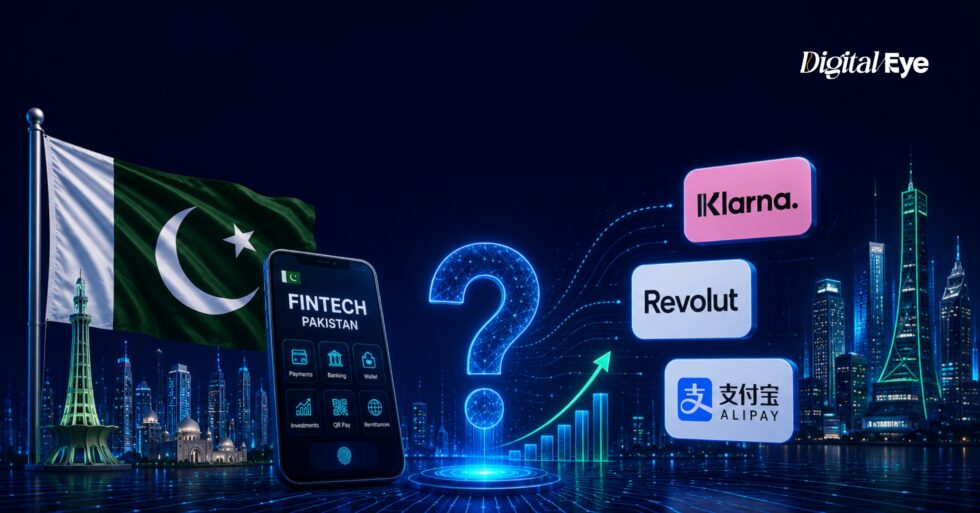
Pakistan has built more fintech infrastructure in the past decade than most people realise. JazzCash serves 48 million registered users. Easypaisa became the country’s first licensed digital retail bank in January 2025. RAAST, the State Bank’s instant payment rail, processed 89 percent of all retail transactions by early 2025. The country has 450 fintech companies, $391 million in cumulative venture capital, and remittance corridors connecting 10 million overseas Pakistanis to the domestic economy.
Yet ask which Pakistani fintech is competing globally, and the honest answer is: almost none of them yet.
Sweden’s Klarna processes $127.9 billion in annual payment volume across 57 countries. Brazil’s Nubank serves 120 million customers across three countries and is now applying for a US bank charter. Revolut, founded in the UK, is investing $13 billion to expand into 30 new markets by 2030. China’s Ant Group has connected 88 million merchants in 57 countries through Alipay+.
Each of these companies started from a domestic market with constraints not dissimilar to Pakistan’s. Each found a specific mechanism to go global. The question worth examining is not whether Pakistan’s fintech can be exported. It is whether Pakistani fintechs understand the playbooks that made these four companies exportable, and whether they are willing to execute them.
What Each of the Four Did to Cross Borders
Klarna — Sweden to the World via Merchant Networks
Klarna’s domestic dominance was built on a single insight: Swedish consumers distrusted entering card details online, so Klarna offered invoice-based pay-after-delivery as a trust bridge. By 2014 it held 30 percent of Swedish e-commerce transaction volume.
But the export was not simple. Klarna nearly failed in Germany because credit behaviour differed from Sweden, forcing a full product redesign. The lesson it learned became its template for every subsequent market: enter through merchant partnerships first, adapt the credit model to local behaviour, and use those merchant relationships to acquire consumers at near-zero cost. The US became its biggest growth engine through this exact mechanism, reaching 29 million active American users by early 2026.
The export mechanism: Merchant-led distribution, local credit model adaptation, regulatory compliance as a prerequisite not an obstacle.
Revolut — UK to 65 Countries via Regulatory Sequencing
Revolut’s founding insight was simpler: international money transfer was absurdly expensive and slow, and the people most affected were exactly the young, mobile, internationally active consumers most likely to adopt a new app. Its UK e-money licence became the legal basis for EU expansion. Banking licences, obtained market by market, came later.
The company targeted expats and frequent travellers first in every new market. These users had the highest willingness to switch and the lowest attachment to incumbent banks. They also had strong social networks that drove organic referral growth. Revolut is now committing $13 billion to expansion across 30 new markets by 2030, targeting 100 million customers.
The export mechanism: Regulatory sequencing (e-money licence first, full banking licence second), diaspora and traveller acquisition first, viral referral second.
Nubank — Brazil to Latin America via the Unbanked
Nubank was founded in 2013 in São Paulo by Colombian-American David Velez. His entry point was Brazil’s most excluded consumer: the 40 percent of adults without a credit card, facing banks with branch queues, annual fees, and opaque terms. A no-fee digital credit card accessible entirely by smartphone changed that equation.
The export logic was structural: the same problem, namely an entrenched, expensive, and inaccessible traditional banking system, existed across all of Latin America. Nubank’s model travelled from Brazil to Mexico to Colombia not because it was clever marketing but because the underlying conditions were identical. It now serves 120 million customers across those three markets and is testing the US market with a bank charter application.
The export mechanism: Own one underserved segment completely at home, replicate in markets with structurally identical problems, sequence regulatory entry market by market.
Alipay / Ant Group — China to the World via Diaspora Corridors
Alipay did not attempt to displace Visa or Mastercard in foreign markets. Instead, it followed the money: Chinese tourists and workers spending abroad needed a way to pay without friction. Alipay built QR-code acceptance at merchants in Japan, Thailand, and Singapore where Chinese tourism was highest, creating a network effect that benefited both Chinese travellers and local merchants.
When Ant wanted to enter markets where Chinese tourists were not the primary audience, it invested in local e-wallets rather than competing with them: Kakao Pay in South Korea, 2C2P in Singapore, and stakes in wallet operators across South and Southeast Asia. Alipay+ now connects 1.5 billion consumer accounts across 25 e-wallets and bank apps in 57 countries.
The export mechanism: Follow the diaspora first, then invest in local infrastructure partners rather than competing with them head-on.
What Pakistan Has Built and Where It Could Export
Pakistan’s fintech infrastructure is more mature than its international reputation suggests. RAAST delivers real-time payment settlement. Haball has processed over $3 billion in B2B payments and is already in GCC expansion. Easypaisa, JazzCash, NayaPay, and SadaPay together have built mobile money infrastructure that reaches demographics no bank branch has ever served. The Roshan Digital Account has mobilised the overseas Pakistani diaspora into a formalised investment and remittance channel that crossed $8 billion in deposits within three years of launch.
Remittances alone represent a structural export opportunity. Pakistan received remittances equivalent to 9.4 percent of GDP in 2024, ranking fifth globally by volume. That diaspora of 10 million Pakistanis in the UK, US, UAE, Saudi Arabia, and Canada is not just a source of inbound money. It is a ready-made distribution channel for fintech products the same way Chinese tourists were for Alipay.
Three specific corridors exist for Pakistani fintech to export, if the playbooks are followed deliberately.
The diaspora corridor:
A Pakistani fintech that solves the remittance and cross-border payment experience for overseas Pakistanis has a captive audience of millions in high-income markets who are already motivated to move money home efficiently. This is the Alipay-follows-Chinese-tourists model applied to a Pakistani context. The Roshan Digital Account proved there is demand. The product layer on top of that demand has barely been built.
The Islamic finance corridor:
Shariah-compliant financial products are structurally underserved in every Muslim-majority economy globally. Pakistan has deeper Islamic finance expertise than almost any other country, and Haball’s success with Shariah-compliant supply chain finance is proof that this expertise has commercial export value. The GCC is the most immediate opportunity, but the same model applies to Turkey, Indonesia, Malaysia, Bangladesh, and the Muslim-majority communities in European markets. This is Pakistan’s version of Nubank’s unbanked thesis: own one underserved segment globally that nobody else has credibly addressed.
The B2B infrastructure corridor:
Approximately 85 percent of B2B payment flows in Pakistan were still cash-based as recently as 2022. The companies that have solved digital B2B payments in Pakistan’s complex environment, including fragmented banking relationships, regulatory layers, and SME trust constraints, have built something genuinely exportable to any emerging market with similar characteristics. GCC, West Africa, and South and Southeast Asia all have analogous B2B payment infrastructure gaps.
What Still Needs to Happen
None of the four benchmarks exported accidentally. Each made deliberate strategic choices that Pakistan’s fintech ecosystem has not yet made at scale.
Capital remains the sharpest constraint. Klarna raised over $4 billion before its IPO. Revolut is deploying $13 billion in its current expansion cycle. Pakistan’s entire fintech VC history totals $391 million. The gap is not insurmountable, but it requires either international institutional capital or a strategic partnership with a sovereign or corporate anchor that can fund the licensing and market entry costs that cross-border expansion demands.
Regulatory competency needs to become a strategic asset, not an afterthought. Every successful export in this list was built on deliberate regulatory sequencing. Pakistan’s fintechs are sophisticated domestically but largely untested in navigating foreign regulatory environments. Building that competency, whether through hiring experienced compliance teams, partnerships with established international players, or dedicated regulatory strategy functions, is not optional for any company that takes global expansion seriously.
Finally, trust. Pakistani brands carry a perception deficit in some international markets that Swedish, Brazilian, or British companies do not face to the same degree. This is addressable through demonstrated track record, third-party validation, and deliberate brand investment in target markets. It takes longer than product development. It needs to start earlier.
The Honest Verdict
Pakistan’s fintech can be exported. The infrastructure exists. The talent exists. The diaspora corridor is one of the most obvious untapped distribution advantages in the emerging market fintech space. But none of the four companies in this comparison became global by accident or by simply building a good domestic product and waiting. They identified a specific mechanism, a specific market, and a specific customer segment, and they executed against it relentlessly.
Pakistan’s fintech ecosystem has produced excellent domestic builders. The next question is whether it will produce global exporters?