
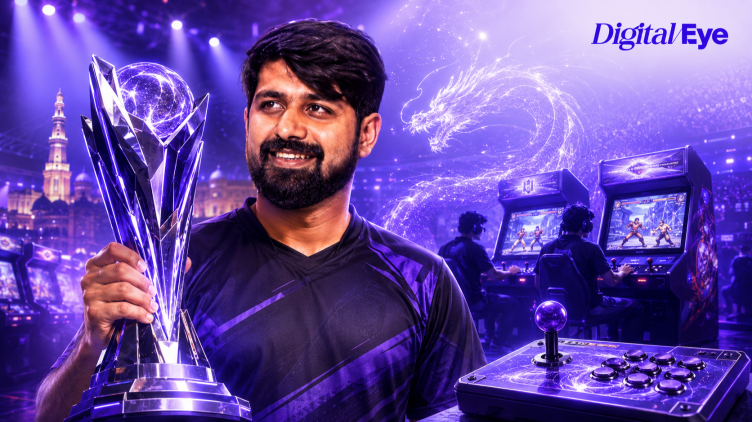
M Zubair won $250,000 at the Esports World Cup in Paris. But this moment belongs to every Pakistani gamer who came before him too.
On 7 August 2026, Muhammad Zubair sat across from South Korea’s LowHigh in the grand final of the Esports World Cup in Paris and won 5–0. He took home $250,000 from a $1 million prize pool and was crowned Tekken 8 world champion at the largest esports event on the global calendar.
Getting there, however, was not easy. Standing in his way was perhaps Tekken’s greatest player, eight-time EVO champion Arslan Ash. Perhaps the most recognizable name in Pakistani esports history, Arsalan was the favorite going into the tournament. With more EVO titles than any player in the competition’s 30-year history, he had undoubtedly blazed the trail that Zubair would eventually follow to the throne.
Zubair’s first match-up with Arslan came in the group stage, where he won 3–0. But the eight-time EVO champion fought his way back through the tournament, setting up a semifinal rematch that went right down to the wire, with Zubair taking five games to Arslan’s four. He had now beaten Pakistan’s greatest Tekken player twice in the same tournament. And yet, his arrival does not really feel like an upset.
There is a new generation of gamers emerging in Pakistan from the same system that produced Arslan Ash. We have already seen players such as Atif Butt, Imran Khan, Awais Honey, and Adeel Shaikh reach major international finals, either winning or finishing as runners-up. Pakistan’s growing dominance in the Fighting Game Community is beginning to resemble what South Korea built in Multiplayer Online Battle Arena games, where an unusually competitive local environment continues to produce players capable of competing at the highest level internationally.
Pakistani players had been competing at that level for years. The rest of the world simply had no way of knowing until Arslan Ash flew to EVO Japan in 2019. With back-to-back EVO victories, Arslan did more than validate himself as world-class. He validated the entire local gaming scene that had helped him get to that level.
The Arcade Scene in Lahore
The Lahore arcade community that produced both Arslan Ash and Muhammad Zubair is rooted partly in a simple economic reality. A PlayStation console in Pakistan costs roughly $700, while the average monthly salary is around $300. Private console ownership was never the path available to most players, but the arcade was.
Maniax Gaming Hub in Lahore, run by Zamin Abbas for more than 15 years, became one of its crucibles. You paid per session. You played against whoever was there. You could not afford to waste credits, so you learned quickly, under pressure and against real competition. There was no casual mode and no ranked queue to climb at your own pace. Every session was competitive.
At various points, three of the world’s top ten Tekken players were training at Maniax simultaneously. What emerged from that density is what coaches in almost every sport describe as the iron-sharpens-iron effect. When the competition inside your training environment is genuinely world-class, you can reach that level long before you ever leave your city.
So when Arslan Ash stepped onto the EVO Japan stage in 2019, he was not discovering his ceiling. He was showing the world something Lahore already knew. Perhaps the most extraordinary external validation came later that year, when Knee, one of the most celebrated Korean Tekken players of all time, flew to Lahore specifically to train. He played 42 sessions at Maniax over three days and went 39–3. The result was understandably reported as another dominant showing for the Korean legend.
But I think the more interesting detail is that Knee, at the height of his powers, looked across the global Tekken landscape and decided Lahore was where he needed to be.
The Players We Are Missing
The fighting game story is the clearest chapter in Pakistan’s competitive gaming history. But it raises a question worth asking: how much talent is the rest of the world missing because of infrastructure?
Tekken is, by its nature, an offline game. It is played on equal terms regardless of where you are. The ping that cripples a Pakistani player in a Valorant ranked match, the server latency that costs reaction time in a Counter-Strike firefight, the connection instability that turns a Dota 2 teamfight into a lottery, none of these apply on an arcade cabinet or at a local Tekken tournament. Pakistani players competed on a level playing field and won the world championship. More than once.
It is worth sitting with the uncomfortable question that this raises. If Pakistan can produce eight-time EVO champions in a title where latency does not matter, how many Pakistani players are currently among the best in the world in titles where it does, invisible to international rankings simply because 200 milliseconds of extra ping means the difference between competing and not? The players who would have been SumaiL in Valorant, who would have been the Pakistani equivalent of the Korean CS:GO dynasties, may already exist. They just cannot show it yet.
That changes as internet infrastructure improves and regional server coverage expands. It is one of the most compelling reasons to watch what Pakistan’s gaming generation does over the next five years.
The Numbers and the Stories
Pakistan’s competitive gaming culture is backed by an extraordinary demographic profile. The population exceeds 240 million with a median age of 20.6 years. There are approximately 50 million gamers, a number that grew by nearly 22 per cent between 2021 and 2026, alongside 194 million mobile connections reaching 75.9 per cent of the population.
In PC gaming, Sumail Hassan, born in Karachi, sold his bicycle as a child to afford more Dota hours. His family moved to Illinois in 2012. At 16, he won The International 2015, the Dota 2 world championship, becoming the youngest player ever to earn more than a million dollars in esports prize money. The same hunger that built the Lahore arcade scene had found a different outlet.
In mobile, 4Thrives Esports won the PUBG Mobile Global Open 2026 South Asia Finals in Lahore in May, then won $62,500 in Jakarta and qualified for the PUBG Mobile World Cup. The previous year they finished seventh at the World Cup and earned $157,000, the highest result ever achieved by any Pakistani esports organisation.
Pakistan’s Federal Cabinet approved the country’s first national esports policy in July 2026. Dedicated esports arenas and training academies are planned for major cities. The infrastructure is beginning to catch up to what the talent has already proved it can do.
A Run or a Movement?
Here is the honest question: is what Pakistan is experiencing in competitive gaming a remarkable run, or the beginning of something that reshapes what gaming means for young Pakistanis as a career and as a culture?
South Korea offers the most instructive comparison. Korean esports dominance did not begin with a single player or a single title. It began when the country decided, collectively and through policy, that competitive gaming was a legitimate professional path. PC-bangs, government-backed leagues, broadcast rights, sponsored academies, and a cultural shift in how parents viewed gaming as a career built a generation of professionals and a global phenomenon. Today, Korean esports generates billions in economic activity and produces athletes who are national celebrities.
Pakistan has Arslan Ash, who has won more EVO titles than any player in history and who paved the way for every Pakistani gamer who came after him. It has M Zubair, who just beat him at the Esports World Cup and walked away with a quarter of a million dollars. It has SumaiL, who sold a bicycle in Karachi and became a world champion. It has 4Thrives, competing on global PUBG Mobile stages. It has 50 million gamers and a median age of 20.
Whether this becomes a movement, whether Pakistani competitive gaming produces the infrastructure, the professional pathways, and the investment that turns individual brilliance into a sustained national story, remains to be decided. But the raw material is clearly there. The players have been proving it for years. The question is whether Pakistan builds a platform worthy of them.