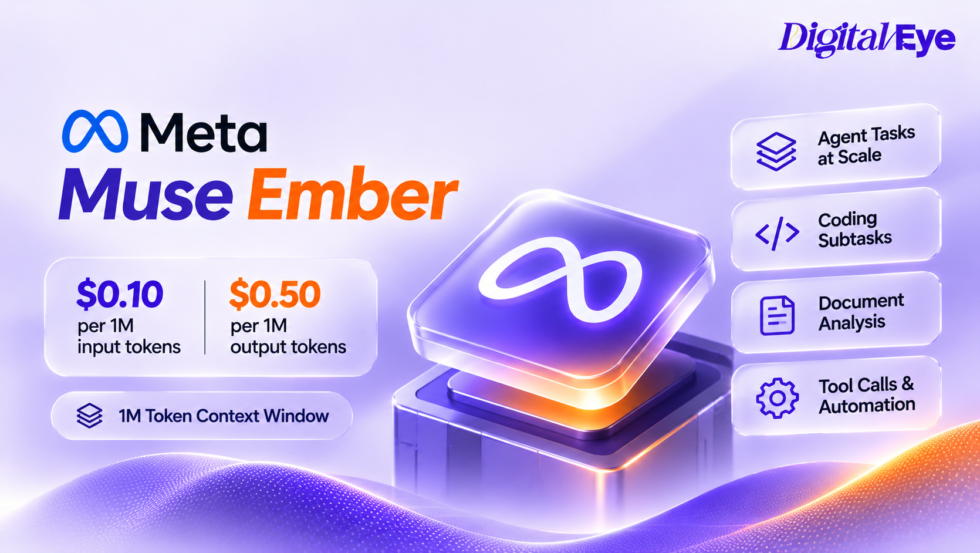
Meta Muse Ember launched on November 9, 2026, as a lightweight artificial intelligence model designed for high-volume agent tasks. Meta prices the system at $0.10 per million input tokens and $0.50 per million output tokens, targeting developers who need to run repeated tool calls, coding subtasks and document analysis without the cost of a larger model.
The company describes Muse Ember as its smallest and most efficient model in the Muse family. It is available through the Meta Model API and Muse Code, with an advertised one-million-token context window. Performance claims in the announcement combine published benchmark references with company-run tests, so they require careful interpretation.
Meta Muse Ember Focuses on Repetitive Agent Tasks
Meta Muse Ember is built for work that agents carry out repeatedly while completing larger assignments. Examples include routing tasks to tools, extracting information, checking code, navigating document sets and processing structured records across software applications.
Those tasks may look modest individually, but they can account for substantial computing use when an automated system performs hundreds or thousands of steps. Using a capable lower-cost model for predictable subtasks can reduce spending, leaving larger models for complex planning or final decisions.
Meta says Muse Ember was trained using Muse Wonder Full and is intended to complement more capable models in its portfolio. It positions Muse Wonder for harder reasoning, Muse Spark for coding and agent workflows, and Ember for routine execution at scale.
Muse Ember Pricing and Context Limits
The listed API price is $0.10 per million input tokens, $0.004 per million cached input tokens and $0.50 per million output tokens. Meta says the system supports up to one million tokens of context and up to 512,000 output tokens. These limits are maximum published specifications, not a promise that every application will use its full capacity effectively.
The advertised rates make costs easier to estimate for teams building business agents, but API token pricing is only one part of total operating expenses. Tool calls, retries, application infrastructure, human review and security monitoring can also influence the cost per completed task.
Meta compared its intelligence-to-cost results with other small models, including Claude Haiku 5.5 and GPT-6 Luna, and reported favorable performance on several measures. Those comparisons depend on the chosen workloads, reasoning settings and model configurations. Developers should test their own use cases rather than treating a single composite score as universally decisive.
Model Benchmarks Show Strengths and Limitations
In results presented by Meta, Muse Ember scored 37.8% on AutomationBench-AA, compared with 13.9% for Claude Haiku 5.5 and 20.2% for GPT-6 Luna under the specified settings. On Terminal-Bench 4.0, Ember achieved 40.9%, compared with 39.2% and 16.4% respectively.
The same disclosure also shows areas where Ember does not lead. On FrontierCode 2.0, an evaluation of engineering tasks judged on whether code is ready to merge, Claude Haiku 5.5 scored 34.9% while Ember reached 27.2%. The results argue against interpreting the release as an across-the-board performance victory.
Meta says early partners including Box, Oracle, Cloudflare and You.com have tested the model in contract review, engineering workflows and other enterprise scenarios. Their statements describe initial experience, not broadly audited evidence of deployment outcomes.
Safety and Enterprise Deployment
Before release, Meta says it evaluated Muse Ember against chemical and biological misuse, cybersecurity and loss-of-control risks, and found results below its framework’s highest risk thresholds. It also reports tests of whether the model follows user intent, protects sensitive information and resists instructions hidden inside external content.
That testing matters for models expected to use tools and handle enterprise data. Organizations still need to control which systems their agents can access, which actions require approval and how errors are detected. A smaller model’s lower price does not remove operational responsibilities.
What Happens Next
The next test will be adoption by developers who can compare real task completion rates, latency and total cost against alternatives. Independent evaluations will also help establish how results change outside Meta’s published benchmarks.
The launch confirms a new pricing and capability option for the growing market in AI agents. Whether Muse Ember becomes a standard component of enterprise automation will depend on consistent performance, developer tools and governance in everyday production work.